Exploring the Impact of Artificial Proprioception on Postural Stability in Individuals with Transtibial Prosthesis
DOI:
https://doi.org/10.17488/RMIB.46.3.1494Keywords:
artificial proprioception, postural stability, transtibial prostheses, sensory feedback, balance controlAbstract
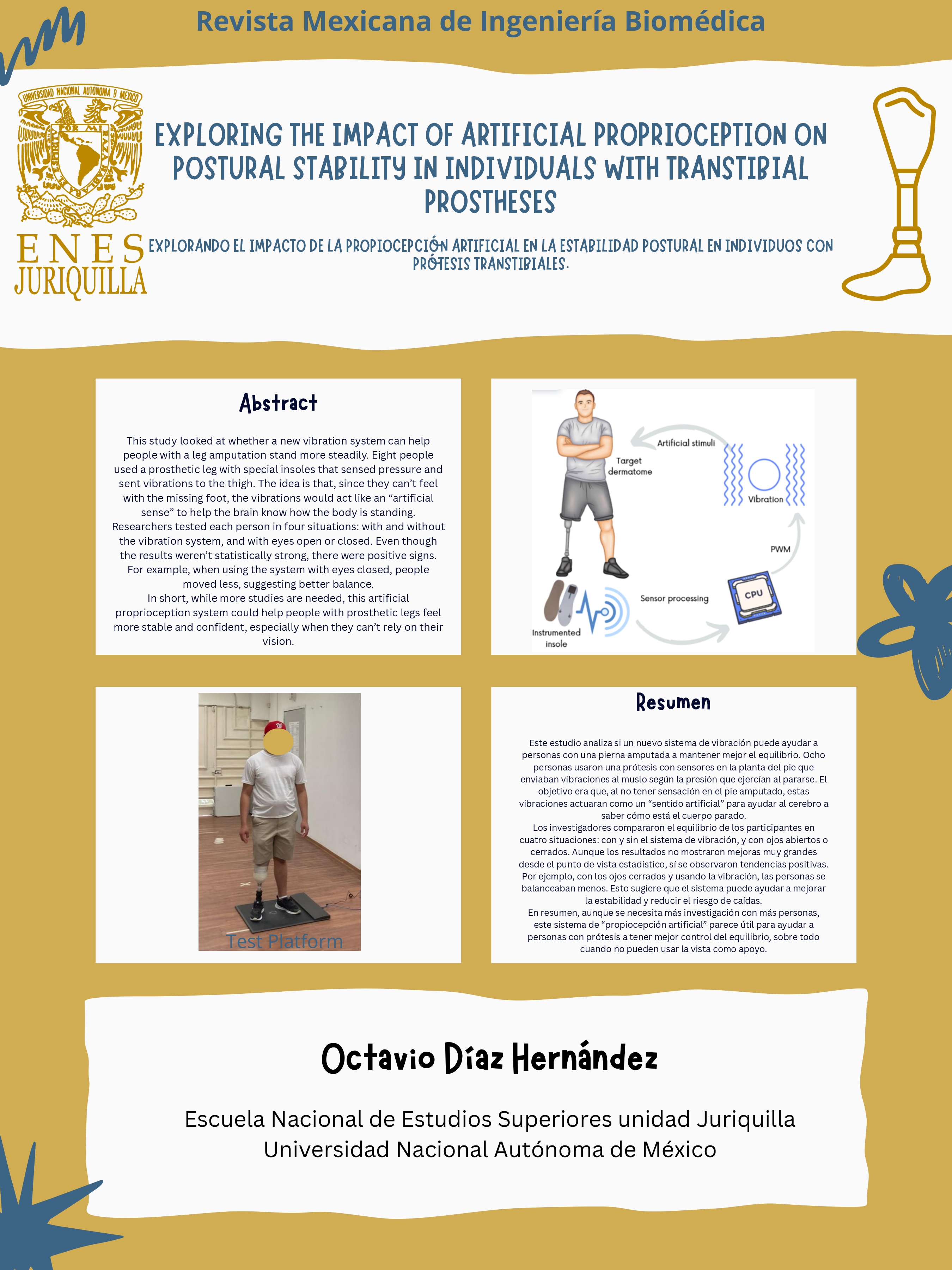
This study investigates the effects of Artificial Proprioception (AP) on postural stability in transtibial amputees using a non-invasive mechatronic system. Eight participants with unilateral lower-limb amputation underwent stabilometric evaluations under four visual and sensory conditions (with/without AP, eyes open/closed) using a baropodometric platform. The AP system translated plantar pressure from instrumented insoles into vibrotactile feedback via actuators positioned on dermatome-mapped regions of the thigh. Time-series analyses, pressure maps, and center of pressure (COP) dynamics were assessed through metrics such as displacement, velocity, sway area, and Romberg indices. While statistical significance was not achieved, descriptive trends revealed a reduction in COP variability, particularly in eyes-closed conditions, suggesting enhanced postural control. The system’s proportional feedback and anatomical mapping may facilitate improved somatosensory integration and compensatory motor strategies. These findings support AP as a promising tool for balance rehabilitation in lower-limb amputees, warranting further study with larger cohorts and dynamic tasks.
Downloads
References
I. Fagioli et al., “Advancements and Challenges in the Development of Robotic Lower Limb Prostheses: a Systematic Review,” IEEE Trans Med Robot Bionics, 2024, doi: 10.1109/TMRB.2024.3464126.
J. N. Mello, M. R. Garcia, A. C. P. R. da Costa, and A. B. Soares, “Towards optimum amplitude and frequency of electrotactile stimulation in amputee for effective somatotopic sensory feedback,” Research on Biomedical Engineering, vol. 41, no. 1, pp. 1–16, Mar. 2025, doi: 10.1007/S42600-024-00385-0/TABLES/7.
A. Demofonti et al., “Restoring somatotopic sensory feedback in lower limb amputees through non-invasive nerve stimulation,” Cyborg and Bionic Systems, Feb. 2025, doi: 10.34133/CBSYSTEMS.0243.
R. Valette, S. Manz, J. Gonzalez-Vargas, and S. Dosen, “Intuitive omnidirectional vibrotactile feedback from a sensorized insole for lower limb prostheses users,” Oct. 07, 2024, Authorea. doi: 10.36227/techrxiv.172833629.91719237/v1.
M. N. Kalff et al., “Impact of Gait-Synchronized Vibrotactile Sensory Feedback on Gait in Lower Limb Amputees,” Applied Sciences 2024, Vol. 14, Page 11247, vol. 14, no. 23, p. 11247, Dec. 2024, doi: 10.3390/APP142311247.
J. M. Canton Leal, J. V. Gyllinsky, A. A. Arredondo Zamudio, and K. Mankodiya, “HapticLink: A Force-based Haptic Feedback System for Single and Double Lower-Limb Amputees,” in 2022 44th Annual International Conference of the IEEE Engineering in Medicine & Biology Society (EMBC), IEEE, Jul. 2022, pp. 4226–4229. doi: 10.1109/EMBC48229.2022.9871460.
C. Basla, L. Chee, G. Valle, and S. Raspopovic, “A non-invasive wearable sensory leg neuroprosthesis: Mechanical, electrical and functional validation,” J Neural Eng, vol. 19, no. 1, p. 016008, Feb. 2022, doi: 10.1088/1741-2552/ac43f8.
F. C. G. Di Zubiena, L. D’Alvia, Z. Del Prete, and E. Palermo, “A static characterization of stretchable 3D-printed strain sensor for restoring proprioception in amputees,” in FLEPS 2022 - IEEE International Conference on Flexible and Printable Sensors and Systems, Proceedings, Institute of Electrical and Electronics Engineers Inc., 2022. doi: 10.1109/FLEPS53764.2022.9781497.
F. C. G. Di Zubiena et al., “FEM deformation analysis of a transtibial prosthesis fed with gait analysis data: A preliminary step towards restoring proprioception in amputees,” in 2021 IEEE International Workshop on Metrology for Industry 4.0 and IoT, MetroInd 4.0 and IoT 2021 - Proceedings, Institute of Electrical and Electronics Engineers Inc., 2021, pp. 493–498. doi: 10.1109/MetroInd4.0IoT51437.2021.9488482.
A. Gardetto et al., “Reduction of phantom limb pain and improved proprioception through a tsr‐based surgical technique: A case series of four patients with lower limb amputation,” J Clin Med, vol. 10, no. 17, Sep. 2021, doi: 10.3390/JCM10174029.
F. M. Petrini et al., “Enhancing functional abilities and cognitive integration of the lower limb prosthesis,” Sci Transl Med, vol. 11, no. 512, Oct. 2019, doi: 10.1126/scitranslmed.aav8939.
G. Valle, G. Preatoni, and S. Raspopovic, “Connecting residual nervous system and prosthetic legs for sensorimotor and cognitive rehabilitation,” in Somatosensory Feedback for Neuroprosthetics, Elsevier, 2021, pp. 293–320. doi: 10.1016/B978-0-12-822828-9.00007-1.
R. A. Coker, E. R. Zellmer, and D. W. Moran, “Micro-channel sieve electrode for concurrent bidirectional peripheral nerve interface. Part B: Stimulation,” J Neural Eng, vol. 16, no. 2, 2019, doi: 10.1088/1741-2552/AAEFAB.
B. P. Christie, E. L. Graczyk, H. Charkhkar, D. J. Tyler, and R. J. Triolo, “Visuotactile synchrony of stimulation-induced sensation and natural somatosensation,” J Neural Eng, vol. 16, no. 3, p. 036025, Jun. 2019, doi: 10.1088/1741-2552/ab154c.
L. Yang, P. S. Dyer, R. J. Carson, J. B. Webster, K. Bo Foreman, and S. J. M. Bamberg, “Utilization of a lower extremity ambulatory feedback system to reduce gait asymmetry in transtibial amputation gait,” Gait Posture, vol. 36, no. 3, pp. 631–634, Jul. 2012, doi: 10.1016/j.gaitpost.2012.04.004.
F. Barberi, E. Anselmino, A. Mazzoni, M. Goldfarb, and S. Micera, “Toward the Development of User-Centered Neurointegrated Lower Limb Prostheses,” IEEE Rev Biomed Eng, vol. 17, pp. 212–228, 2024, doi: 10.1109/RBME.2023.3309328.
A. Ghiami Rad and B. Shahbazi, “A systematic investigation of sensorimotor mechanisms with intelligent prostheses in patients with ankle amputation while walking,” J Mech Behav Biomed Mater, vol. 151, p. 106357, Mar. 2024, doi: 10.1016/j.jmbbm.2023.106357.
S. Raspopovic, G. Valle, and F. M. Petrini, “Sensory feedback for limb prostheses in amputees,” Nat Mater, vol. 20, no. 7, pp. 925–939, Jul. 2021, doi: 10.1038/s41563-021-00966-9.
G. Preatoni, G. Valle, F. M. Petrini, and S. Raspopovic, “Lightening the Perceived Prosthesis Weight with Neural Embodiment Promoted by Sensory Feedback,” Current Biology, vol. 31, no. 5, pp. 1065-1071.e4, Mar. 2021, doi: 10.1016/j.cub.2020.11.069.
F. C. G. Di Zubiena, M. Paolucci, L. D’alvia, Z. Del Prete, and E. Palermo, “A 3-D-Printed Elastomeric Strain Sensor With Mechanical and Thermal Characterization for Restoring Proprioception in Lower Limb Amputees,” IEEE Trans Instrum Meas, vol. 73, 2024, doi: 10.1109/TIM.2024.3436116.
L. Chee, G. Valle, G. Preatoni, C. Basla, M. Marazzi, and S. Raspopovic, “Cognitive benefits of using non-invasive compared to implantable neural feedback,” Sci Rep, vol. 12, no. 1, p. 16696, Oct. 2022, doi: 10.1038/s41598-022-21057-y.
O. Diaz-Hernandez, I. Salinas-Sanchez, A. Santos-Borraez, and S. Vargas-Vidal, “Device for Artificial Proprioception Applied to Lower Limb Prosthesis,” in XLVII Mexican Conference on Biomedical Engineering, B. and R.-L. J. J. and H. A. H. Y. and A. L. G. and Z.-A. E. and D. H.-G. E. and S.-R. R. A. Flores Cuautle José de Jesús Agustín and Benítez-Mata, Ed., Cham: Springer Nature Switzerland, 2025, pp. 79–88. doi: 10.1007/978-3-031-82126-4_8.
O. Diaz-Hernandez and I. Salinas-Sanchez, “Towards Artificial Proprioception in Prosthetic Devices,” International Journal of Medical Science, vol. 10, no. 1, pp. 1–5, Feb. 2023, doi: 10.14445/23939117/IJMS-V10I1P101.
J. L. Taylor, “Proprioception,” Encyclopedia of Neuroscience, pp. 1143–1149, Jan. 2009, doi: 10.1016/B978-008045046-9.01907-0.
F. Tjernström, M. Björklund, and E. M. Malmström, “Romberg ratio in quiet stance posturography—Test to retest reliability,” Gait Posture, vol. 42, no. 1, pp. 27–31, Jun. 2015, doi: 10.1016/J.GAITPOST.2014.12.007.
T. Paolucci et al., “Romberg ratio coefficient in quiet stance and postural control in Parkinson’s disease,” Neurol Sci, vol. 39, no. 8, pp. 1355–1360, Aug. 2018, doi: 10.1007/S10072-018-3423-1.
A. Field, Discovering statistics using IBM SPSS statistics, vol. 58. 2013.
Downloads
Published
How to Cite
Issue
Section
License
Copyright (c) 2025 Revista Mexicana de Ingenieria Biomedica

This work is licensed under a Creative Commons Attribution-NonCommercial 4.0 International License.
Upon acceptance of an article in the RMIB, corresponding authors will be asked to fulfill and sign the copyright and the journal publishing agreement, which will allow the RMIB authorization to publish this document in any media without limitations and without any cost. Authors may reuse parts of the paper in other documents and reproduce part or all of it for their personal use as long as a bibliographic reference is made to the RMIB. However written permission of the Publisher is required for resale or distribution outside the corresponding author institution and for all other derivative works, including compilations and translations.